
Choosing the right Kava product starts with understanding what separates standard options from carefully sourced selections. The term best quality Kava is often linked with factors such as origin, cultivar details, processing methods, and product transparency.
With many options available, knowing what to check before purchasing can make the selection process easier. This best Kava quality guide explains the key quality indicators to look for when comparing Kava products and choosing premium options with confidence.
✔️Best Quality Kava: Quick Selection ChecklistBefore exploring each factor in detail, here are the main points to consider when evaluating Kava quality:
|
What Does “Best Quality Kava” Actually Mean?
The quality of Kava depends on several factors, including where it is grown, how it is processed, and how clearly product details are provided.
Origin and Growing Region
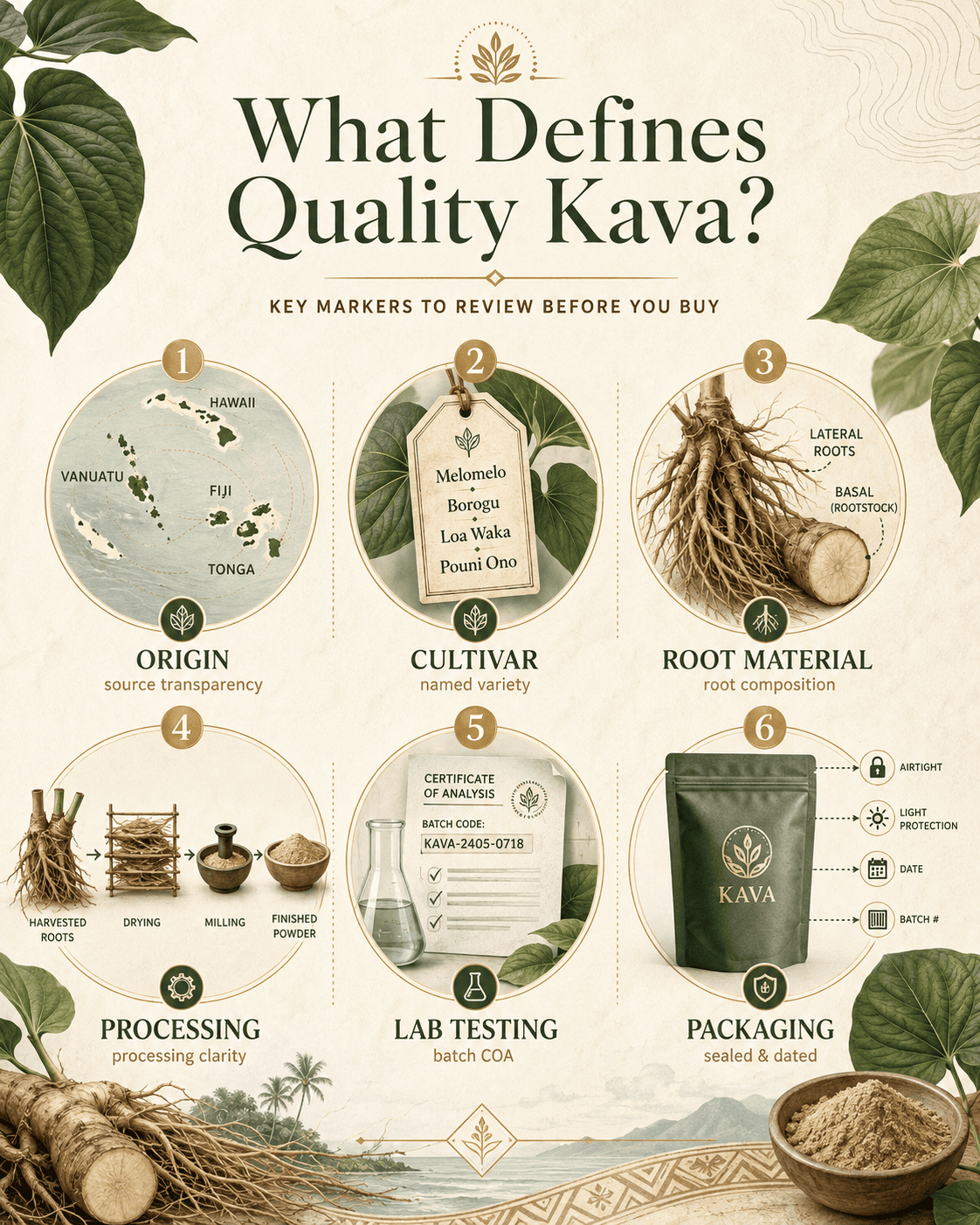
The region where Kava is grown provides important context about its origin and traditional classification. Pacific Island regions such as Vanuatu, Fiji, Tonga, and Hawaii are known for Kava cultivation, with each area having its own agricultural practices and cultural history.
When comparing Kava products, origin details can help customers understand where the plant material comes from and evaluate product transparency.
⭐Look for information such as:
Country or island of origin
Specific growing region
Source details
Cultivation information
Kava Cultivar Information
Beyond geographic origin, the specific Kava cultivar provides more insight into the plant variety used in a product. A cultivar refers to a distinct variety of the Kava plant, with each variety having its own traditional name and agricultural background.
Instead of using only broad descriptions such as “Kava root,” quality-focused suppliers may provide the specific cultivar name on the product page or packaging.
👉 Examples of named cultivars include:
Melomelo (Vanuatu)
Borogu (Vanuatu)
Loa Waka (Fiji)
Pouni Ono (Tonga)
⭐When reviewing cultivar details, look for:
The specific cultivar name
The growing region connected to the cultivar
Clear source information
Product labeling that identifies the plant variety
Plant Material and Processing Standards
The type of plant material used in a Kava product is an important factor when evaluating quality and transparency.
Kava is primarily derived from underground plant parts, including lateral roots and the central rootstock, also known as the basal stump.
Quality-focused suppliers typically provide details about the root composition used in their products rather than using only broad descriptions.
Information about the plant material helps customers better understand what goes into the final product.
⭐When reviewing a best quality Kava product, look for:
Clear identification of the root material used
Details about lateral roots, rootstock, or other underground portions
Transparency about plant composition
Information about processing methods
How to Identify Premium Kava Products
After understanding the main factors that influence high quality Kava, the next step is reviewing the information and documentation provided by the supplier.
Review Product Documentation
A well-documented Kava product should provide clear information that allows customers to understand the product specifications before purchasing.
⭐When reviewing product details, look for:
Complete ingredient information
Product specifications
Manufacturer details
Batch or lot identification
Available product documentation
Review Lab Testing Information
Laboratory documentation provides additional information about product verification and consistency. Many quality-focused suppliers provide a Certificate of Analysis (COA) that includes testing details for specific product batches.
⭐When reviewing lab documentation, look for:
Batch-specific COA availability
Lab testing information from an independent laboratory
Product details that match the tested batch
Clearly presented testing records
Accessible testing documentation provides additional transparency when evaluating different Kava products.
Check Packaging and Storage Details
Packaging details clearly define how the product has been handled. Look for:
Packaging Detail | Why It Matters |
Airtight, resealable packaging | Limits exposure to air and moisture |
Opaque or light-blocking bags | Reduces light exposure during storage |
Harvest or packing date | Helps you gauge freshness |
Batch or lot number | Ties the product to its specific lab report |
Understanding Noble Kava and Other Kava Classifications
Not all kava plants are classified the same way, and this distinction is one of the most important things to understand before buying.
Noble Kava vs Non-Noble Kava
Noble Kava refers to a specific group of premium Kava (Piper methysticum) cultivars that have been traditionally grown and harvested for centuries across the South Pacific islands.
Non-noble Kava—often referred to as Tudei (two-day) Kava—is a category of fast-growing Kava cultivars that are widely discouraged or legally restricted from regular consumption.
Category | Chemotype Pattern | Common Use |
Noble Kava | Begins with 2 or 4 in the chemotype sequence | Standard for retail and export |
Non-Noble / Tudei | Different chemotype pattern | Restricted or avoided in most markets |
Vanuatu's export regulations specifically restrict the sale of non-Noble Kava outside the country, which is part of why origin labeling matters so much when evaluating a product.
Kava Product Formats: Comparing Available Options
Kava is sold in several different formats, and each one is processed differently before it reaches the shelf.
Format | What It Is | Preparation Needed |
Raw root powder | Ground, dried Kava root | Requires kneading/straining in water |
Instant Kava | Pre-processed, water-soluble powder | Dissolves directly in water |
Capsules | Powdered root in capsule form | No preparation |
Tinctures | Liquid extract form | Measured drops, no preparation |
Choosing a Kava format mainly depends on how much preparation you prefer.
Kavalactone Content: What the Percentage on the Label Tells You
Beyond cultivar and chemotype patterns, Kava labels often list a kavalactone percentage — a separate data point worth understanding on its own.
What are Kavalactones?
Kavalactones are natural plant compounds found in the roots of the Kava plant (Piper methysticum). Many quality-focused manufacturers include kavalactone information as part of their product specifications, helping customers better understand the product they are purchasing.
Typical Ranges in Premium Root
Quality-focused suppliers typically report a specific percentage rather than omitting this detail altogether. Premium Noble Kava root commonly falls within an 8–16% kavalactone range, though this can vary by cultivar, harvest, and processing method.
Looking Beyond Kavalactone Percentage When Comparing Kava Products
A kavalactone percentage is useful, but it works best alongside the other quality indicators already covered — cultivar name, origin, and lateral root composition. A high percentage on a vague or poorly labeled product is less meaningful than a moderate percentage backed by full sourcing transparency.
Kavalactones vs Chemotypes
Although they are often mentioned together, kavalactones and chemotypes describe different aspects of a Kava product.
Label Detail | What It Tells You |
Kavalactone percentage | Concentration of compounds in the tested batch |
Chemotype sequence | Classification pattern (Noble vs. non-Noble) |
Red Flags to Avoid When Buying Kava Online
Before making a final choice, watch for warning signs that may point to weak product transparency or unreliable seller practices.
🚩Conflicting information across listings: The cultivar, ingredients, product quantity, or format should match across the product page, package label, and supporting documents.
🚩Identical specifications used for every batch: Repeated kavalactone or chemotype figures across multiple lots may indicate that current batch data is not being provided.
🚩Unsupported quality superlatives: Claims such as “highest grade,” “number one,” or “best available” require clear specifications rather than promotional wording alone.
🚩No clear seller contact channel: Avoid listings where basic product questions cannot be directed to a named company, email address, or customer-support team.
🚩Unusually low pricing without an explanation: A major price difference deserves closer review, especially when the listing does not explain the source, package quantity, or reason for the discount.
💡 Trying Kava for the first time? Read our guide on Kava before you buy:
Frequently Asked Questions
1. What Does "Premium Grade" Kava Actually Mean?
Premium grade Kava generally refers to Noble Kava made primarily from lateral root material, with a clearly stated cultivar, origin, and batch-specific lab documentation. It's a combination of plant classification and sourcing transparency, not a single standardized label.
2. Does The Smell Of Kava Determine Its Quality?
Smell alone isn't a reliable quality indicator, since it can vary by cultivar, freshness, and processing method. Origin, cultivar name, and lab documentation are far more accurate ways to judge a product.
3. Where Can I Buy Premium Kava Online?
Premium Kava can be purchased from established botanical retailers that provide complete labels, clear product specifications, and accessible testing information. MIT Therapy currently has a dedicated online Kava collection with multiple product options from Kava shots to gummies.
💡 Know more on — Where to Buy Kava: Your Complete Guide
4. Is Kava From Vanuatu Better Than Kava From Fiji Or Tonga?
Vanuatu is widely recognized for its strict export standards limiting non-Noble Kava sales, but Fiji and Tonga also produce well-documented Noble cultivars. Quality depends more on cultivar, processing, and documentation than on origin alone.
5. What Is Single-Cultivar Kava?
Single-cultivar Kava is made from one specific, named variety — like Melomelo or Borogu — rather than a blend of multiple cultivars. This makes it easier to trace chemotype, kavalactone content, and origin back to one consistent source.
6. How Long Does Kava Stay Fresh After Opening?
Freshness depends on the format and storage conditions, but airtight, resealable packaging kept away from light and moisture helps preserve root powder longest. Checking the harvest or packing date on the label is the most reliable way to gauge how fresh a batch is.
💡 Related reads: |
Disclaimer: This content is provided for general educational purposes only and does not offer medical advice or make claims about diagnosing, treating, curing, or preventing any condition. Kava products are not approved by the FDA for such purposes. Product regulations may vary by location, so review applicable local laws before purchasing. Follow all label directions, avoid combining Kava with alcohol, and do not drive or operate machinery after use.