
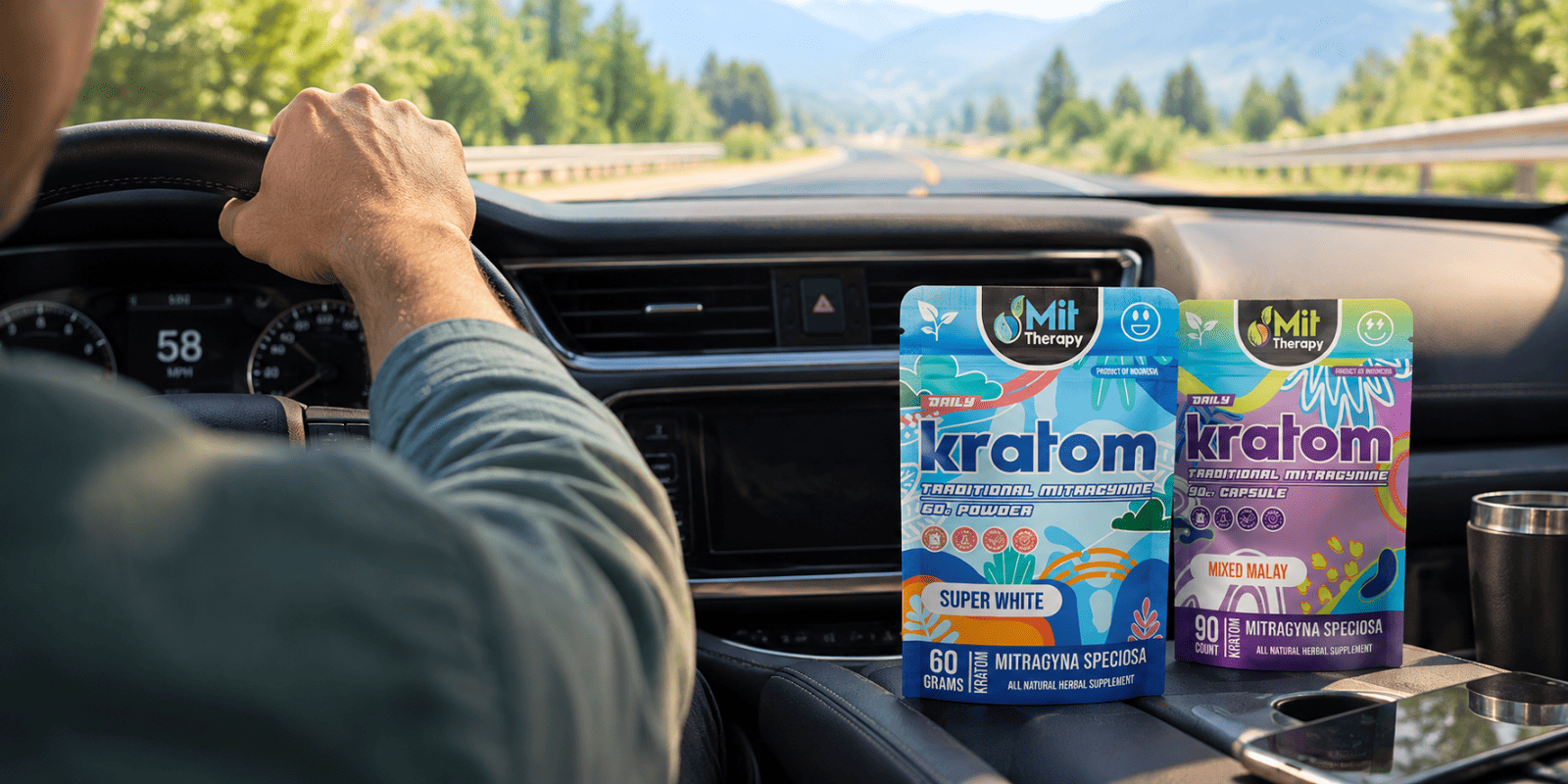
 No, it is not universally safe to drive after taking kratom because it can cause unpredictable side effects like drowsiness, slow reflexes, and blurry vision. A 2024 peer-reviewed study found no significant overall change in simulated driving among a small group of regular Kratom consumers, but the sample was far too limited to prove general safety.
So, what does the research actually tell us about Kratom and driving? This guide will take you through DUI laws, major safety concerns, and the key factors that can influence driving after Kratom use.
Kratom and Driving safety: Key Takeaways
|
Table of Contents
Can You Drive After Taking Kratom?
How Does Kratom Potentially Affect Driving Ability?
What Factors Can Influence Driving After Taking Kratom?
Can You Get a DUI for Driving After Taking Kratom?
Kratom and Driving: What to Consider Before You Drive?
FAQs
Can You Drive After Taking Kratom?
No, you should avoid driving after taking kratom because its effects on your brain and body are highly unpredictable. Kratom contains natural active chemicals that bind to your brain's receptors.
Depending on how much you take, the quality of the batch, and your personal body chemistry, Kratom can quickly change how well you steer, brake, and focus.
💡What the Current Research Says?
The main study is a 2024 paper in Traffic Injury Prevention by researchers at the Johns Hopkins University School of Medicine and the National Institute on Drug Abuse Intramural Research Program. (PubMed)
Survey and monitoring: 357 US adults who regularly use Kratom completed a survey and a 15-day momentary assessment.
Simulator test: 10 adults took their usual Kratom products and drove a high-fidelity simulator before and after.
Survey findings: Over 90% of participants reported driving after using Kratom, most reported low rates of risky driving, and they rated their driving confidence as high.
Simulator findings: There were no significant changes in the main simulated driving measures. Only one of the ten participants showed a modest increase in lane drift and a drop in a car-following score.
The wider picture:CDC states that more research is required to fully understand how drugs influence driving skills.
Does That Mean Kratom Is Safe for Driving?
No. The study does not show that Kratom is safe for driving, and its design limits what can be concluded.
Very small simulator group: Ten participants can miss real differences.
Regular users only: New and infrequent users were not tested.
Self-selected products and amounts: Results cannot be tied to any specific amount or product.
No placebo or control group: The paper states this limits how the driving results can be interpreted.
How Does Kratom Potentially Affect Driving Ability?
Kratom directly impacts your brain and nervous system, which can change how you physically handle a car and how quickly you process road hazards.
Here are the Kratom effects on driving ability:
Reaction Time
The Risk: Delayed braking and slow avoidance maneuvers.
What may happen: In larger amounts, kratom slows down your nervous system. If a car in front of you suddenly stops or a pedestrian steps into the road, it can take your brain longer to process the danger and tell your foot to step on the brake.
Attention and Perception
The Risk: Missed road signs and drifting out of your lane.
What may happen: Safe driving requires you to pay attention to multiple things at once, like watching your speed, checking mirrors, and looking for signs. Kratom can cause a "foggy" mental state, making it hard to focus on your surroundings or spot sudden hazards.
Coordination and Vehicle Control
The Risk: Jerkiness, shaky steering, and poor pedal control.
What may happen: Low amounts of kratom can cause jitters, muscle tremors, or anxiety, while high amounts can ruin your physical balance. These physical side effects make it difficult to make smooth steering adjustments or maintain steady pressure on the gas pedal.
Judgment and Decision-Making
The Risk: Taking unnecessary risks due to a false sense of security.
What may happen: Because research shows that most daily kratom users feel highly confident behind the wheel, drivers often underestimate their actual impairment. This false confidence can cause you to drive when you are secretly too tired, follow other cars too closely, or make risky lane changes.
What Does the Research Say About Kratom and Driving Impairment?
Kratom impairment and driving risks are hard to quantify because the two study types measure different things.
Measure | How It Was Collected | What It Shows | What It Cannot Show |
National Survey (N = 357) | One-time self-report questionnaire | How often participants drive after Kratom and how they describe their driving | Actual driving performance |
Momentary Assessment (15 Days) | Repeated self-reports in daily life | Participants’ own ratings within 15–180 minutes of use | Whether ratings match real performance |
Driving Simulator (n = 10) | Measured lane position and car-following before and after use | Objective performance for 10 regular users | Results for new users, other products, or a no-Kratom comparison |
What the 2024 Driving Study Found About Self-Reported Impairment
Driving after Kratom was common: Over 90% of surveyed participants reported doing so.
Low self-reported risk: Most reported low rates of risky driving behavior.
High confidence: Participants rated their driving ability as high and reported little impairment within 15 to 180 minutes of use.
Why Self-Reported Driving Confidence Is Not Proof of Safety
Confidence is a belief, not a measurement: Performance has to be tested separately.
The objective data is small: Only 10 participants completed the simulator test.
NHTSA's guidance does not depend on how you rate yourself: If someone is impaired, whatever term they use, they should not drive.
Interpretation: The self-reports describe how regular users view their own driving. They do not establish that driving is unimpaired.
What Factors Can Influence Driving After Taking Kratom?
The Total Amount You Take
Your dose completely changes how your body reacts. Low amounts (1 to 5 grams) usually act as a stimulant, which can cause physical jitters or anxiety behind the wheel.
High amounts (over 5 grams) act as a strong sedative, heavily slowing your muscle reflexes and delaying your braking times.
The Specific Type of Kratom Product
Traditional Kratom powder or brewed teas pass slowly through your digestive system, causing gradual effects. Before choosing a product, learn how to pick the Best Kratom Powder and understand why product characteristics matter when considering potential effects. Highly concentrated liquid extract shots bypass this process and spike rapidly in your bloodstream, which can trigger sudden, unexpected drowsiness or "nodding off" while you are actively driving.
Your Personal Experience and Tolerance
Your history with the botanical dictates your physical response.
Daily users build up a heavy metabolic tolerance that can temporarily mask driving impairments, as noted in the 2024 simulator study.
However, new, casual, or infrequent users have zero tolerance and are highly prone to sudden dizziness or "the wobbles" (involuntary eye twitching) that ruin your vision.
Time Since Taking Kratom
The danger level changes depending on the clock.
Kratom chemicals reach their peak concentrations in your blood within one to two hours after consumption, making this the highest-risk window for active side effects.
Furthermore, even as the initial effects fade, the subsequent "comedown" brings a wave of fatigue that causes dangerous lapses in your attention span.
Mixing Kratom With Other Substances
Combining substances creates the most hazardous driving environment possible.
Mixing Kratom with alcohol, over-the-counter allergy pills (like Benadryl), or prescription anti-anxiety medications severely multiplies central nervous system depression.
This leads to severe lane-weaving and sudden micro-sleeps behind the wheel.
Can You Get a DUI for Driving After Taking Kratom?
Yes, you can absolutely be arrested and convicted of a Driving Under the Influence (DUI) offense after taking Kratom.
Traffic safety laws focus entirely on your actual physical and mental fitness to operate a vehicle safely. A plant's legal status does not protect you from criminal impairment charges.
Is Driving After Taking Kratom Automatically a DUI?
No Universal Blood Limit: Unlike alcohol, which has a strict 0.08% legal limit nationwide, there is no set blood threshold or automatic "cutoff level" for Kratom.
The Requirement of Proof: Simply having kratom in your body does not mean an automatic conviction. To arrest or convict you, the police and prosecutors must prove that the kratom actively made you a "less safe driver."
Evidence of Impairment: Law enforcement relies on visible proof—like swerving across lanes, slow braking, or failing a roadside balance test—to build an impairment case against you.
How Can The Police Prove That You Have Taken Kratom?
No Breathalyser Exists: Because police cannot use a breath test for kratom, they must prove you are physically or mentally unfit to drive.
Specialist Officer Exams: Police use Drug Recognition Experts (DREs) to spot physical signs like shaky balance, abnormal pupil sizes, or involuntary eye twitching.
Blood and Urine Tests: If arrested, you will face a laboratory toxicology test. Modern labs can easily detect mitragynine (the active chemical in kratom) in your system.
Legal Precedents: Courts rule that any substance altering your brain functions counts as an impairing drug. For example, a Pennsylvania appeals court reinstated a DUI charge for a driver with only kratom and caffeine in his blood.
Kratom and Driving: What to Consider Before You Drive?
To prevent traffic accidents and legal issues, keep these points in mind:
Do Not Drive If Altered: If you feel even slightly changed, stay off the road. Impaired drivers should never get behind the wheel, no matter how they label their symptoms.
Plan Your Ride Early: Arrange a ride-share or a designated driver before you use kratom so you are never tempted to drive later.
Obey "Heavy Machinery" Warnings: Never mix Kratom with other substances. Labels warning against operating heavy machinery explicitly include driving a standard car.
Check Local and Work Rules: Banned cities and company contracts often enforce much stricter drug laws and penalties than general state rules.
⭐Wish to know more on the rules and regulations of Kratom? Read our detailed guides before you buy any product: |
FAQs
Is Kratom Safe To Drive On?
No, kratom is not safe to drive on because it can cause unpredictable side effects like drowsiness, blurry vision, and slow reflexes. Even if you feel energetic or highly confident, the active chemicals can still secretly impair your physical coordination behind the wheel.
How Long After Taking Kratom Can You Drive?
The safest approach is to wait at least 4 to 6 hours after taking kratom, or until its physical and mental effects have completely worn off. Because everyone’s metabolism is different, you should never drive if you feel even slightly altered, heavy-eyed, or lightheaded.
Does Kratom Show Up On A Dot Drug Test?
No, kratom does not show up on a standard Department of Transportation (DOT) 5-panel drug test, which only checks for specific illegal and prescription substances. However, individual transportation employers can still order specialized laboratory tests to check for kratom if they suspect impairment.
Can The Police Tell If I Have Used Kratom?
Yes, police can tell if you have used kratom by deploying specially trained Drug Recognition Experts (DREs) to examine your eyes, balance, and coordination. If you fail their roadside tests, they will order a laboratory blood sample, which easily detects Kratom chemicals in your system.
Can You Get A Dui For Driving On Kratom?
Yes, you can absolutely get a criminal DUI for driving on kratom, even in cities and states where the plant is completely legal to buy. Traffic safety laws focus entirely on whether your driving is impaired, and any substance that alters your brain function counts as an intoxicating drug under the law.
Disclaimer: This article is for general educational purposes only and should not be considered legal or medical advice. Research on Kratom and driving remains limited, and individual circumstances may vary.
Driving and DUI laws differ by state and jurisdiction, so always check current local regulations. If you believe your ability to drive may be impaired, do not operate a vehicle.