
You can edit text on your website by double clicking on a text box on your website. Alternatively, when you select a text box a settings menu will appear. your website by double clicking on a text box on your website. Alternatively, when you select a text box
How to Read a Kratom Lab Report (COA): The 5 Numbers That Actually Matter
If you shop for kratom for any length of time, you will eventually land on a website that claims its products are "lab tested." It might even link to something called a certificate of analysis, or COA. The problem is that nobody teaches you how to read one. You open a PDF, scroll past product names and company logos, and hit a wall of scientific abbreviations, percentages, and numbers that look meaningful but mean very little to an untrained eye. That wall is exactly where a lot of bad habits start, and exactly where good buyers can protect themselves.
This guide walks you through the parts of a certificate of analysis that actually matter, so you can check a report in under two minutes and know, with confidence, whether the product you are about to buy passes the test.
What a Certificate of Analysis Actually Is
A certificate of analysis is a document issued by a testing laboratory after it analyzes a sample of a product. On a well-run lab report, you will find the product name, the batch or lot number, the date the sample was tested, the method used, and the results for specific compounds. The lab does the measuring. Your job is simply to verify that the right things were measured, and that the numbers fall where they should.
Two phrases matter more than almost anything else on the document: "third-party" and "batch-specific".
A third-party COA comes from an independent laboratory that has no financial stake in selling the product. That independence is the entire point, because it means the manufacturer cannot quietly influence the result. A batch-specific COA applies to the exact batch you are buying, not a generic report from a different batch that shipped months ago. If a brand shows you a single vague COA and expects it to cover every batch they have ever sold, that report is not doing the work you think it is.
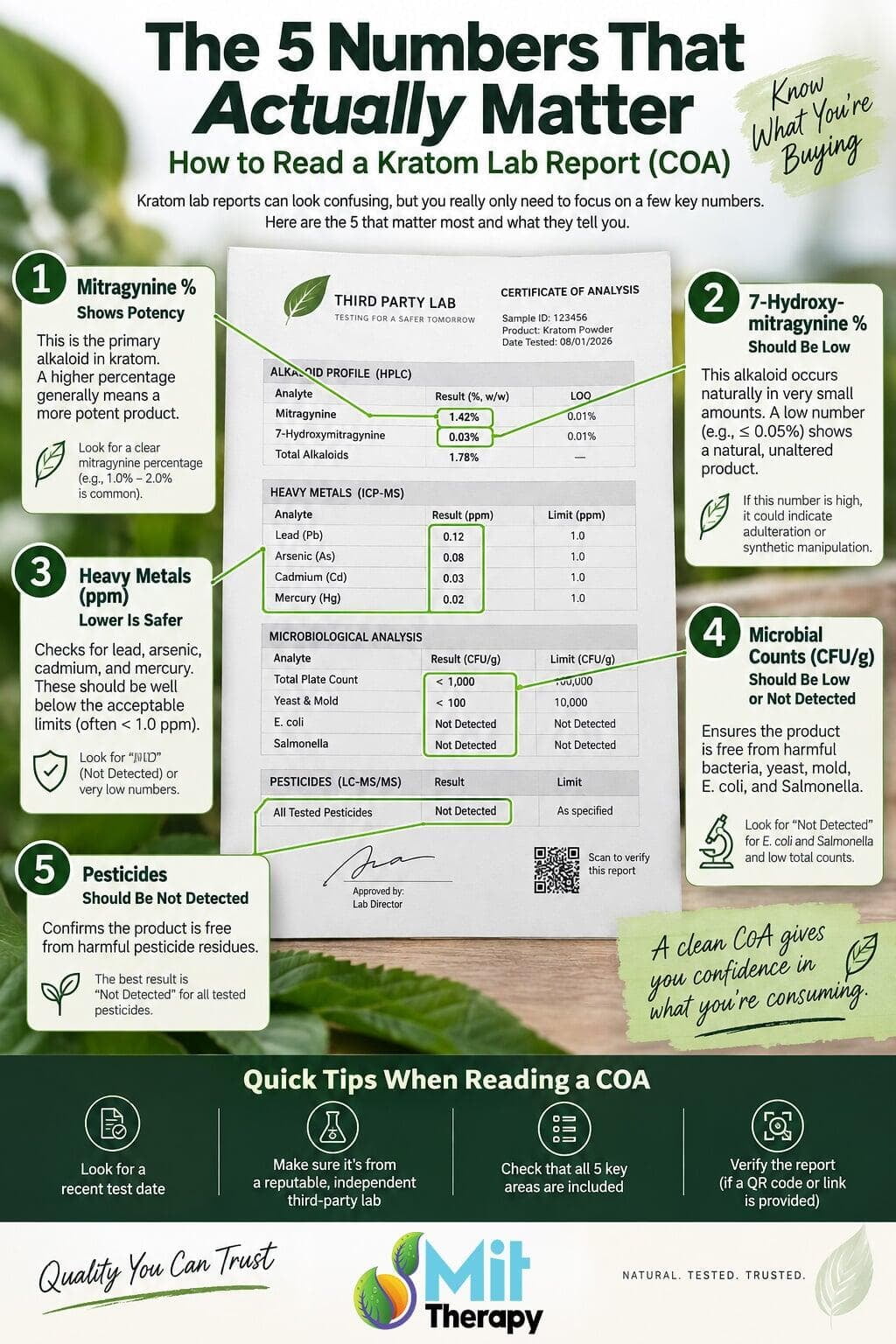
The 5 Numbers You Should Verify Every Time
You do not need to become a chemist to read a lab report. You need to check five things.
1. The Batch Number Matches Your Product
This is the fastest sanity check on the whole page. Find the batch or lot number on the report, then find the matching number printed on the product packaging you are holding. If they do not match, the report has no connection to your product, full stop. A COA for batch A does absolutely nothing to prove that batch B is safe or consistent. Matching the batch number should be your first move every single time.
2. Mitragynine Content
Mitragynine is the primary naturally occurring alkaloid in kratom leaves, and it is the compound that products are most often standardized by. On a report you will typically see it reported as a percentage, like 1.5% or 2.0%, or as a milligram-per-gram value. The specific number is not the point. The point is that there is a number, that it is within the range the brand advertises, and that it is consistent with what the product claims to deliver. When a product is described as "enhanced" or standardized to a specific content, the report should support that claim.
3. Heavy Metal Results
Heavy metals such as lead, arsenic, cadmium, and mercury can appear in botanical products because they are absorbed from the soil in which the plant is grown. A responsible lab report tests for these contaminants and shows the result alongside a limit. The result you want to see is a measurable value that falls below the reference limit shown in the report. If the report lists contaminants at all, that is a good sign. If it lists them and shows them comfortably under the limit, that is an even better sign. If the report does not test for heavy metals at all, that is a genuine gap.
4. Microbial Testing
Microbial testing checks for harmful levels of bacteria, yeast, and mold. Just like heavy metals, the goal is not necessarily a zero result, it is a result that falls within an acceptable, published threshold. A report that shows microbial screening with numbers under the reference limits is the mark of a supplier that treats safety as a routine step rather than an afterthought.
5. Solvent or Residual Findings
Solvents can enter botanical products during extraction, and a thorough lab report addresses them. When you are looking at an enhanced or extracted product, confirming that the report addresses solvents gives you confidence that nothing unwanted was left behind in processing. Even if the values are small, the fact that they were measured and reported tells you a lot about the discipline of the facility behind the product.
Red Flags to Look For
A few warning signs should change how you evaluate a brand.
- If the report is missing batch information or the product name does not match what you purchased, treat the report as decorative.
- If the document looks permanently dated or cannot be matched to an identifiable batch, it is not proving anything about the product in front of you.
- If a brand is vague about whether its testing is third-party, ask for clarity. A confident, transparent supplier can point to a specific independent lab and explain what it tests for and how often. That kind of direct answer is one of the strongest signals of a brand worth buying from.
Why Transparency Is the Real Standard
The best way to judge a kratom brand is to observe how it behaves when you ask about testing. A supplier that has nothing to hide can walk you through its certificate of analysis, name its lab, explain its batch process, and show you that the report on the product you are about to buy is the report for that exact batch. That is the gold standard, and it is exactly the standard to hold every vendor to.
At Mit Therapy, every product is laboratory tested and every batch is traceable. You can see the numbers behind what you purchase before you add it to your cart. When a certificate of analysis is easy to find, easy to match to the right batch, and easy to understand, choosing a safe, consistent product stops being a guessing game and becomes a simple, verifiable process.
👉 View all our current lab reports — including batch‑specific COAs for every product — on our Lab Reports page.
The Bottom Line
Reading a COA does not require a science degree. It requires checking five things: that the batch matches your product, that the primary alkaloid content is reported and consistent, that heavy metals are tested and under the limits, that microbial results are within acceptable thresholds, and that extraction solvents are addressed. Buy from brands that make all five easy to confirm, and you will have removed most of the uncertainty from the buying process by the time you click the checkout button.