
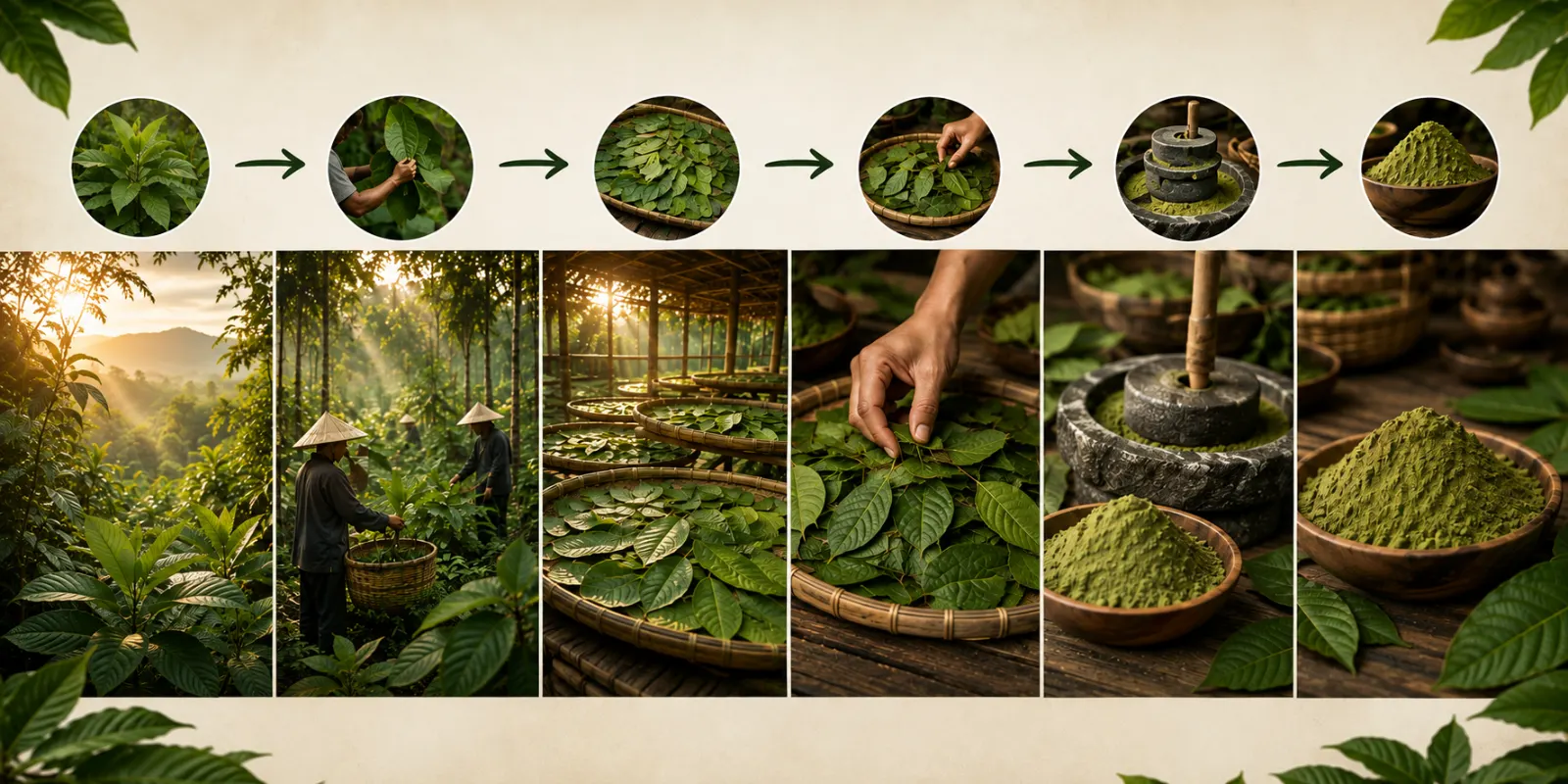
Kratom begins its journey long before it reaches the market. From carefully cultivated trees to harvested leaves and finely processed powder, every stage plays a role in the final product. Understanding how Kratom is made offers a clearer picture of the production process and the standards involved at each step.
In this guide, we'll walk through the complete Kratom production journey, including how is Kratom made, where it grows, how it is harvested, the processing methods used after collection, and how raw leaves are transformed into different products you shop.
Where Does Kratom Come From?
Kratom comes from the Mitragyna speciosa tree, a tropical species native to Southeast Asia. It has been cultivated in countries such as Indonesia, Thailand, Malaysia, where warm temperatures, abundant rainfall, and fertile soil support its growth.
These regions continue to supply a large portion of the global Kratom market through established farming and harvesting practices.
Understanding the Mitragyna speciosa Tree
Mitragyna speciosa belongs to the coffee family, Rubiaceae, and is an evergreen tree that can reach heights of over 50 feet in favorable conditions. It produces broad, dark green leaves that are collected once they reach maturity.
⭐ The tree grows best in environments that provide:
|
Under suitable growing conditions, mature trees can be harvested multiple times each year while continuing to produce new foliage.
How Is Kratom Made? The Cultivation Process
Kratom trees are typically grown from seeds or young saplings in tropical regions with warm temperatures and consistent rainfall. Farmers monitor their growth over several years before the leaves are ready for harvest.
⭐Key cultivation practices include:
|
Most Kratom cultivation is still carried out using traditional manual farming methods across Southeast Asia.
How Kratom Is Harvested?
Harvesting marks the first step after cultivation in the Kratom production process. In most growing regions, leaves are picked by hand, allowing harvesters to select mature leaves while leaving younger growth on the tree.
Collecting Mature Kratom Leaves
Before harvesting, workers inspect each tree to identify fully developed leaves that are ready for collection. Once picked, the leaves are gathered and moved to the processing facility for the next stage.
⭐ The harvesting process typically involves:
|
How Kratom Is Processed?
After harvesting, Kratom leaves move through a series of processing steps before they become ready for manufacturing. Each stage focuses on preparing clean, consistent raw material while maintaining quality standards throughout production.
Sorting and Cleaning Fresh Leaves
Freshly harvested leaves are inspected before processing begins. Any damaged leaves, stems, or unwanted plant material are removed, and the remaining leaves are later washed to eliminate dust and surface debris.
✔️ This step typically includes:
|
Drying Kratom Leaves
Once cleaned, the leaves are dried to reduce their moisture content before milling. The drying methods may change depending on the production facility, local climate, and available equipment.
Drying Method | How Does It Work? |
Indoor Drying | Leaves are placed on drying racks in a controlled environment with regulated airflow. |
Outdoor Drying | Leaves are spread on clean drying surfaces and monitored throughout the drying period. |
Hybrid Drying | A combination of indoor and outdoor drying is used based on weather conditions and production needs. |
During drying, the leaves are checked regularly to promote even moisture reduction before moving to the next stage.
Milling Dried Leaves Into Powder
After drying, the leaves are transferred to industrial milling equipment where they are ground into a fine powder. The powder is then passed through fine mesh screens to create a more uniform particle size before it is collected for testing or further manufacturing.
⭐ The milling process generally involves:
Feeding dried leaves into industrial grinders.
Grinding them into a fine powder.
Sieving the powder to improve consistency.
Collecting the finished powder in clean containers.
Testing Processed Kratom Material
Before processed Kratom material moves to packaging or additional manufacturing, production batches are commonly tested to verify consistency and quality standards.
✔️ This typically checks for:
|
Many manufacturers also maintain Certificates of Analysis (COAs) to document laboratory testing results for individual production batches.
From Kratom Leaf to Different Product Formats
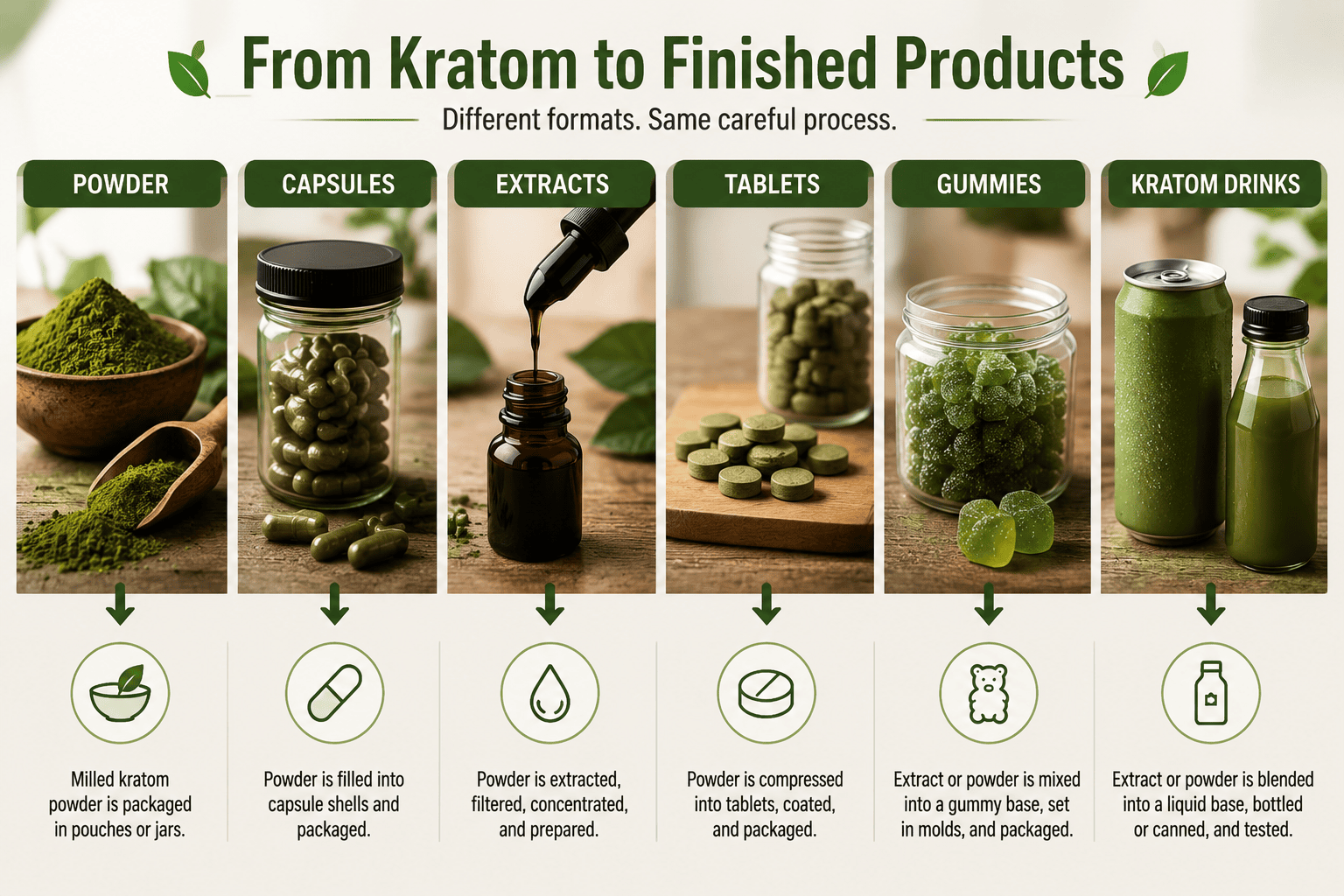
After Kratom leaves are harvested, dried, processed, and tested, the resulting material may be prepared into different product formats. Each format requires additional manufacturing steps depending on the final product design.
The initial processing stage remains the same, while later manufacturing steps vary based on the product category.
🌿How Kratom Powder Is Made
Kratom powder is one of the simplest and traditional formats available in the market. After milling and testing, the powder is prepared for packaging.
✔️The process generally includes:
Separating finely milled powder from cut or crushed leaf material.
Organizing powder batches according to their designated vein color classification.
Packing the finished powder into labeled containers for distribution.
💊How Kratom Capsules Are Made
After the Kratom powder has been processed and tested, it is prepared for capsule manufacturing using automated encapsulation equipment. The filled Kratom capsules are then inspected before being packaged for distribution.
✔️ The manufacturing process generally includes:
Measuring a consistent amount of Kratom powder for each capsule.
Filling gelatin or vegetarian capsule shells.
Inspecting the finished capsules.
Packaging the capsules into bottles or blister packs.
🔎How Kratom Extracts Are Made
Unlike Kratom powder and capsules, extracts undergo an additional manufacturing process to concentrate compounds from the processed leaf material.
Manufacturers use a suitable extraction solvent, such as water, ethanol, or a combination of acid and base solutions, before refining the extract into its final form.
✔️ The manufacturing process generally includes:
Mixing processed Kratom powder with an extraction solvent.
Filtering the mixture to separate the liquid extract from the remaining plant material.
Evaporating the solvent under controlled conditions to concentrate the extract.
Preparing the concentrated extract as a paste, resin, or powder for further manufacturing or packaging.
How Different Kratom Products Are Manufactured
Here’s how different Kratom products are made:
Product | How It Is Made? |
Tablets | Tested powder is mixed with a binding agent, compressed into tablet form, then coated and packaged |
Extract or powder is mixed into a gummy base with flavoring, poured into molds, set, then packaged | |
Extract or powder is blended into a liquid base, bottled or canned, sealed, then batch tested |
💡 Know more about each Kratom form in detail:
Traditional vs Modern Kratom Processing Methods
While the core stages of Kratom production remain similar, the methods used can differ significantly between traditional farming practices and modern manufacturing facilities.
Aspect | Traditional Method | Modern Method |
Harvesting | Fully manual, with leaves picked by hand | Primarily manual harvesting, supported by modern production systems |
Drying | Sun drying or drying on basic indoor racks | Climate controlled drying chambers with monitored conditions |
Milling | Manual grinding or basic milling equipment | Industrial milling with automated sieving for uniform particle size |
Testing | Limited or informal quality checks | Third party laboratory testing with documented batch records |
Batch Size | Small scale, farm level production | Larger, standardized production runs |
Frequently Asked Questions
How Long Does It Take To Process Kratom Leaves Into Powder?
It depends on the drying method used. Sun drying or basic indoor racks can take a few days, while climate-controlled drying rooms speed this up to several hours. Milling into powder is a quick step once the leaves are fully dry.
Can I Buy Kratom Products Online?
Yes you can buy Kratom products online from stores like MIT Therapy. You can check the wide range of Kratom strains and products, and order online.
What Is The Difference Between Crushed Leaf And Kratom Powder?
Crushed leaf is coarser and less processed, often just broken-down leaf pieces. Kratom powder is milled finer and passed through mesh sieves for a consistent texture, making it ready for capsules, blends, or direct use.
Where Can I Buy Kratom Powder Near Me?
Kratom powder is sold at select smoke shops, botanical stores, and specialty Kratom stores. But availability in such stores may vary, and you might not be able to find some specialty strains. Therefore, you can use a store locator and locate the best Kratom stores near me to shop.
What Are The Ingredients In Kratom?
The primary active ingredients in raw Kratom (Mitragyna speciosa) are alkaloids like mitragynine. Additionally, some products like gummies and extracts may include additional ingredients such as sweeteners, or flavoring added during manufacturing.
What Is The Best Way To Store Kratom?
Keep Kratom powder or capsules in an airtight container, away from direct sunlight, heat, and moisture. A cool, dry, dark storage spot helps maintain the material's texture and consistency over time.
💡 Know more on — How To Store Kratom For Maximum Freshness?
Is Kratom Legal To Buy?
Kratom legality varies by state, county, and local regulations. Before purchasing, check the current laws in your specific location to confirm whether Kratom sales are permitted.
📜 Related reads:
Disclaimer: This content is for informational purposes only and covers general Kratom production and processing methods. Manufacturing practices, testing procedures, product details, and regulations may vary by supplier and location. Always verify current information from reliable sources before making decisions regarding Kratom products.