
 If you have spent any time researching Kratom online, you have likely come across the initials AKA attached to vendor pages or state legislation. But what does that actually mean, and why does it show up so often in conversations about Kratom regulation?
The answer connects a decade of advocacy work, a voluntary industry standards program, and a piece of model legislation now active across multiple states. This guide will take you through all of the updated important guidelines on the American Kratom Association.
Table of Contents
Quick Answer: Who Is the AKA?
What Is the American Kratom Association (AKA)?
How Did the American Kratom Association Begin?
What Does the American Kratom Association Do?
What Are the American Kratom Association Standards and Guidelines?
What Does AKA GMP Qualified Mean?
What Is the Kratom Consumer Protection Act (KCPA)?
Who Runs the American Kratom Association?
How Is the American Kratom Association Funded?
How Can You Verify an AKA GMP Qualified Vendor?
American Kratom Association vs FDA: What Is the Difference?
Quick Answer: Who Is the AKA?
The American Kratom Association (AKA) is a nonprofit advocacy organization established in 2014 to represent Kratom consumers and industry interests before lawmakers and regulators. It is best known for its GMP Standards Program for vendors and its model Kratom Consumer Protection Act (KCPA), now enacted in various forms across more than a dozen states.
The AKA and the Evolving 2026 Kratom Landscape: Where Things Stand in 2026?
The American Kratom Association has been central to navigating a rapidly changing regulatory landscape on Kratom. Let’s first see where things stand as of 2026:
Focus Area | Current 2026 Status |
Federal Policy | On July 1, 2026, the DEA temporarily scheduled concentrated/synthetic 7-OH |
Natural Leaf Status | Traditional, natural Kratom leaf remains explicitly legal at the federal level |
State Laws (Reversal) | Rhode Island became the first state to reverse its existing Kratom ban |
State Laws (New Bans) | Louisiana, Connecticut, Kansas, and Tennessee enacted new Kratom restrictions |
The AKA’s Role | The AKA maintained a central role in advocating for the leaf-versus-concentrate distinction |
What Is the American Kratom Association (AKA)?
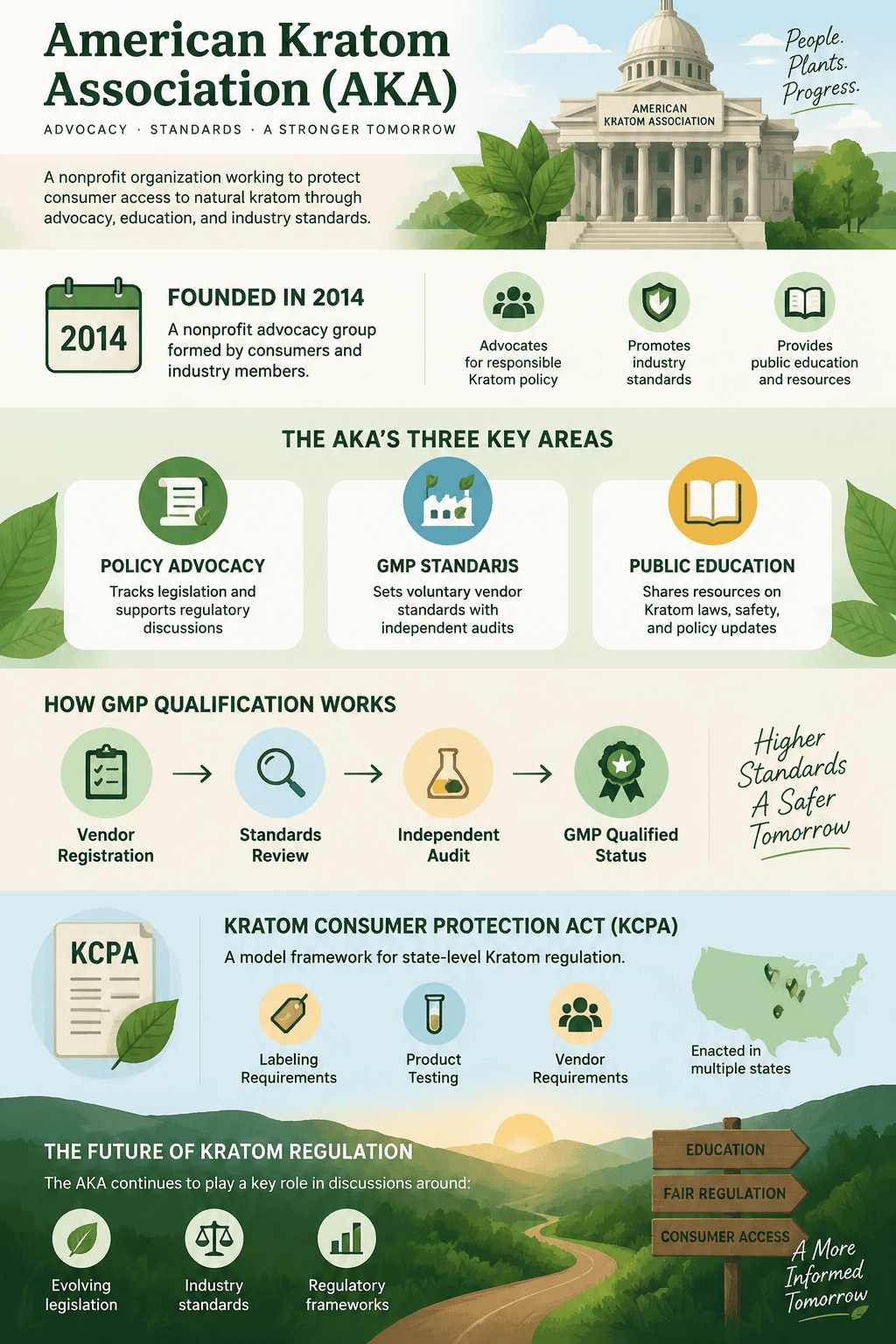
The American Kratom Association (AKA) is a non-profit consumer advocacy group founded in 2014 that works to protect legal and safe consumer access to natural kratom (Mitragyna speciosa) in the United States.
🏤What Type of Organization Is the AKA?
The AKA is registered in Virginia as a nonprofit corporation operating under Section 501(c)(4) of the federal tax code, a category typically used by social welfare and advocacy organizations.
🎯What Is the Main Role of the AKA?
The organization's stated role centers on three areas: legislative advocacy, a voluntary vendor standards program, and public policy education.
How Did the American Kratom Association Begin?
The American Kratom Association (AKA) started as a grassroots organization and gradually grew into a major advocacy group. Its history includes early efforts around Kratom policy, a major federal regulatory debate in 2016, and a later focus on state-level legislation and industry standards.
1. The AKA's Founding in 2014
The AKA formed in 2014 as a small group of Kratom vendors and consumers organized in response to early state and local restrictions on Kratom sales.
2. The 2016 Federal Scheduling Debate
A major turning point for the American Kratom Association (AKA) came in August 2016, when the U.S. Drug Enforcement Administration (DEA) announced plans to place Kratom’s main alkaloids in Schedule I under the Controlled Substances Act.
The AKA responded through several forms of opposition:
👉Congressional and Public Opposition: The AKA supported petitions, rallies, and calls to Congress that helped bring congressional attention to the DEA’s proposal.
👉Research-Based Opposition: The AKA worked with researchers who sent letters to federal agencies arguing that traditional Kratom leaf should be considered separately from classic opioids and that Schedule I status could restrict scientific research.
👉DEA Withdrawal: Following significant public and congressional opposition, the DEA withdrew its August 2016 notice.
3. The Development of State-Level Advocacy
Following the 2016 scheduling debate, the AKA shifted its focus toward state-level legislation, and drafting model regulatory language that became the basis for the Kratom Consumer Protection Act.
4. The Expansion of Industry Standards
Alongside its legislative work, the AKA introduced its Good Manufacturing Practices Standards Program in November 2018, giving vendors a formal, audit-based way to demonstrate compliance with manufacturing and labeling requirements.
Know more about — DEA Kratom Fact Sheet: Facts vs Opinions
What Does the American Kratom Association Do?
The AKA's current activities fall into three main categories: policy advocacy, vendor standards, and public education.
⭐Legislative and Regulatory Advocacy
The AKA tracks Kratom-related bills at both the state and federal levels and develops model legislation for policymakers.
It also communicates directly with lawmakers and regulators, including the FDA, on regulatory proposals involving Kratom products.
⭐Industry Standards and GMP Programs
The AKA runs a voluntary GMP Standards Program for vendors that register with the program.
The program covers requirements related to manufacturing, testing, packaging, and labeling.
⭐Educational and Public Policy Resources
The AKA publishes legislative updates, state-by-state regulatory information, and policy briefs on its website.
These resources provide information about Kratom laws and policy developments for consumers and lawmakers.
What Are the American Kratom Association Standards and Guidelines?
The American Kratom Association (AKA) GMP Standards Program establishes operational requirements for participating vendors. The standards are designed around manufacturing controls, testing procedures, documentation practices, and quality management systems.
The framework is largely based on principles found in federal 21 CFR Part 111, which outlines requirements for dietary supplement manufacturing.
Manufacturing and Processing Requirements
The GMP standards include requirements for maintaining controlled manufacturing environments and documented production procedures.
🎯 Key areas include:
Cleaning schedules for equipment and production areas
Pest control procedures
Climate and environmental controls
Dust-management practices
Personnel hygiene procedures
Appropriate protective clothing requirements
Testing Requirements
Testing is an important part of the AKA standards, with requirements for documented laboratory procedures.
Batches are tested for contaminants such as Salmonella, E. coli, heavy metals, molds, and toxins.
Testing includes alkaloid profiling for mitragynine and 7-Hydroxymitragynine.
Testing procedures must follow documented methods and involve independent laboratories.
Read our detailed guide on — How To Read Kratom Lab Test Results
Packaging and Labeling Requirements
The standards also cover how products are packaged and labeled. Requirements include:
Food-grade and tamper-evident packaging
Complete ingredient information
Required labeling information, including applicable age and warning statements
Storage and Distribution Controls
The GMP standards also cover storage and inventory management practices.
Requirements include:
Proper warehouse conditions
Temperature and humidity controls
First-In, First-Out (FIFO) inventory procedures
Designated areas for materials or batches requiring additional review
Documentation and Recordkeeping
Vendors must maintain detailed records throughout the production process. These include:
Batch Production Records (BPRs) documenting each production stage
Written Standard Operating Procedures (SOPs) for facility processes
Records that support product traceability from incoming materials through final packaging
What Does AKA GMP Qualified Mean?
AKA GMP Qualified refers to a vendor that has completed the American Kratom Association’s GMP qualification process and passed an independent third-party audit. It is important to distinguish this status from basic AKA membership.
AKA Membership vs GMP Qualification
AKA membership and GMP qualification are separate.
AKA Membership: Membership connects individuals, vendors, and other participants with the organization and its advocacy activities. Membership alone does not require a facility audit.
GMP Qualification: This status applies to vendors that have completed the AKA GMP program requirements and passed the required independent audit.
What GMP Qualification Indicates
An AKA GMP Qualified listing indicates that a vendor has completed the qualification process and passed an independent review based on AKA GMP standards.
It indicates that the vendor maintains documented systems related to:
Manufacturing procedures
Recordkeeping
Production processes
Batch traceability
What GMP Qualification Does Not Mean
GMP qualification should not be interpreted as:
Government certification: The AKA is a private nonprofit organization, and GMP qualification is not a federal government certification.
FDA approval: Qualification does not represent approval or authorization from the FDA.
Product endorsement: The qualification applies to vendor processes and facilities, not an endorsement of individual products.
How the GMP Qualification Process Works
The qualification process follows several steps:
Registration: The vendor registers for the AKA GMP program.
Orientation: The vendor reviews the program requirements and receives guidance on the standards.
Preparation: The vendor prepares its facility, procedures, and records for the audit.
Independent Audit: An AKA-approved third-party auditor conducts the required audit.
Documentation Review: The audit report and supporting information are submitted to the AKA for review.
Qualification: After meeting the program requirements, the vendor receives AKA GMP Qualified status. An annual independent audit is required to maintain that status.
What Is the Kratom Consumer Protection Act (KCPA)?
The Kratom Consumer Protection Act (KCPA) is a model state-level legislative framework developed by the AKA. It is designed to regulate the preparation, distribution, and sale of kratom products rather than prohibiting them entirely.
The AKA's Model KCPA Framework
The AKA drafts and promotes a model version of the KCPA that state lawmakers can adapt when introducing Kratom legislation, though the specific provisions vary from state to state as bills move through individual legislatures.
What Areas Can KCPA Legislation Address?
KCPA-style bills commonly address:
Registration: The vendor registers for the AKA GMP program.
Orientation: The vendor reviews the program requirements and receives guidance on the standards.
Preparation: The vendor prepares its facility, procedures, and records for the audit.
Independent Audit: An AKA-approved third-party auditor conducts the required audit.
Documentation Review: The audit report and supporting information are submitted to the AKA for review.
Qualification: After meeting the program requirements, the vendor receives AKA GMP Qualified status. An annual independent audit is required to maintain that status.
Who Runs the American Kratom Association?
The AKA's governance structure separates policy oversight from day-to-day operations.
Board of Directors
The AKA is governed by a board of directors that sets the organization's mission, policies, and programs. Matt Salmon, a former U.S. Representative from Arizona, currently serves as Board Chairman.
Executive Leadership
Day-to-day operations are carried out under executive leadership, with Mac Haddow serving publicly as the AKA's Senior Fellow on Public Policy and primary spokesperson on legislative matters as of 2026.
Organizational Staff
The AKA's board-adopted policies note that an Executive Director and staff, along with a third-party CPA, handle ongoing compliance and financial reconciliation.
How Is the American Kratom Association Funded?
The American Kratom Association (AKA) is a 501(c)(4) nonprofit organization. Its funding supports its advocacy, legislative, and policy activities.
1. Primary Revenue Sources
The AKA’s funding comes from several sources:
Industry Contributions: Financial support from Kratom manufacturers, distributors, and retailers.
Individual Donations: Contributions from individuals and grassroots supporters.
GMP Program Fees: Vendors participating in the voluntary AKA GMP Standards Program pay registration and program-related fees.
2. Public Financial Information
As a nonprofit organization, the AKA files IRS Form 990, which provides public information about its finances.
Public filings can show the organization’s revenue and major expenses, including spending related to:
Lobbying and legislative advocacy
Legal services
Public policy activities
The AKA also states that a third-party CPA assists with financial reconciliation and compliance.
3. Revenue and Tax Status
Public tax filings have reported annual AKA revenue in the multi-million-dollar range, with totals changing from year to year.
Because the AKA is classified as a 501(c)(4) rather than a traditional charitable organization, donations are generally not tax-deductible as charitable contributions. Donors should refer to current IRS rules for their specific situation.
How Can You Verify an AKA GMP Qualified Vendor?
Because some online retailers falsely claim to follow safety protocols, consumers should actively verify a brand's credentials before purchasing. The American Kratom Association (AKA) maintains a public system to confirm compliance.
✔️Check the Official AKA Qualified Vendor Directory
The AKA maintains a Qualified Vendor list on its official website, which is the primary source for confirming a vendor's current status.
✔️Confirm the Vendor's Listing
Search the directory for the specific vendor or brand name rather than a parent company name, since qualification applies to specific facilities and processes.
✔️Check the Current Qualification Information
Because qualification requires annual renewal, confirm that the listing reflects a current audit rather than a status that may have lapsed.
✔️Understand What the Listing Represents
An AKA GMP Qualified listing confirms that a vendor has completed the AKA qualification process and passed the required audit.
It does not represent:
Government approval
FDA certification
AKA endorsement of individual products
American Kratom Association vs FDA: What Is the Difference?
The American Kratom Association (AKA) and the U.S. The Food and Drug Administration (FDA) holds opposing positions regarding the regulation, safety, and legal availability of kratom in the United States.
The table below highlights the direct differences between the two organizations:
Feature | American Kratom Association (AKA) | |
Organization Type | Private 501(c)(4) non-profit consumer advocacy group | Federal government agency under HHS |
Mission | Supports legal access to natural Kratom through regulation | Protects public health by regulating drugs and food safety |
Stance on Kratom | Views natural Kratom as a safe botanical that should remain legal and regulated | Warns about potential risks related to Kratom, including addiction, abuse, and dependence |
Regulatory Goal | Promotes the Kratom Consumer Protection Act (KCPA) for state-level regulation | Has recommended scheduling Kratom as a controlled substance and restricting imports |
Authority | No legal enforcement power; relies on voluntary vendor compliance programs | Has federal enforcement authority, including product seizures and public warnings |
Read more on — FDA and Kratom: Where Do Things Stand Today?
Looking Ahead: The AKA’s Role in the Future of Kratom
The American Kratom Association plays an important role in shaping discussions around Kratom policy, industry standards, and consumer education.
Through initiatives like the GMP Standards Program and KCPA framework, the AKA provides resources that support transparency and regulatory conversations. As Kratom laws continue to evolve, the organization remains a key participant in discussions between lawmakers, vendors, and the public.
FAQs
Does The AKA Test Kratom Products Itself?
No. Testing is carried out by independent, AKA pre-approved laboratories as part of a vendor's own audit process, not directly by AKA staff.
Is The American Kratom Association A Government Agency?
No. The AKA is a private nonprofit advocacy organization. It has no regulatory or enforcement authority and is separate from any federal or state government body.
Is There A Cost To Become An Aka Member?
General public membership through the AKA's website is free and donation-based. This is separate from the GMP Standards Program, where participating vendors pay a registration and annual audit fee.
Read next:
Disclaimer: This article is for informational purposes only and does not represent legal, medical, or regulatory advice. Kratom laws and regulations can change, and readers should check current federal and state guidelines before making decisions. The American Kratom Association (AKA) is a private advocacy organization and is not a government agency.