
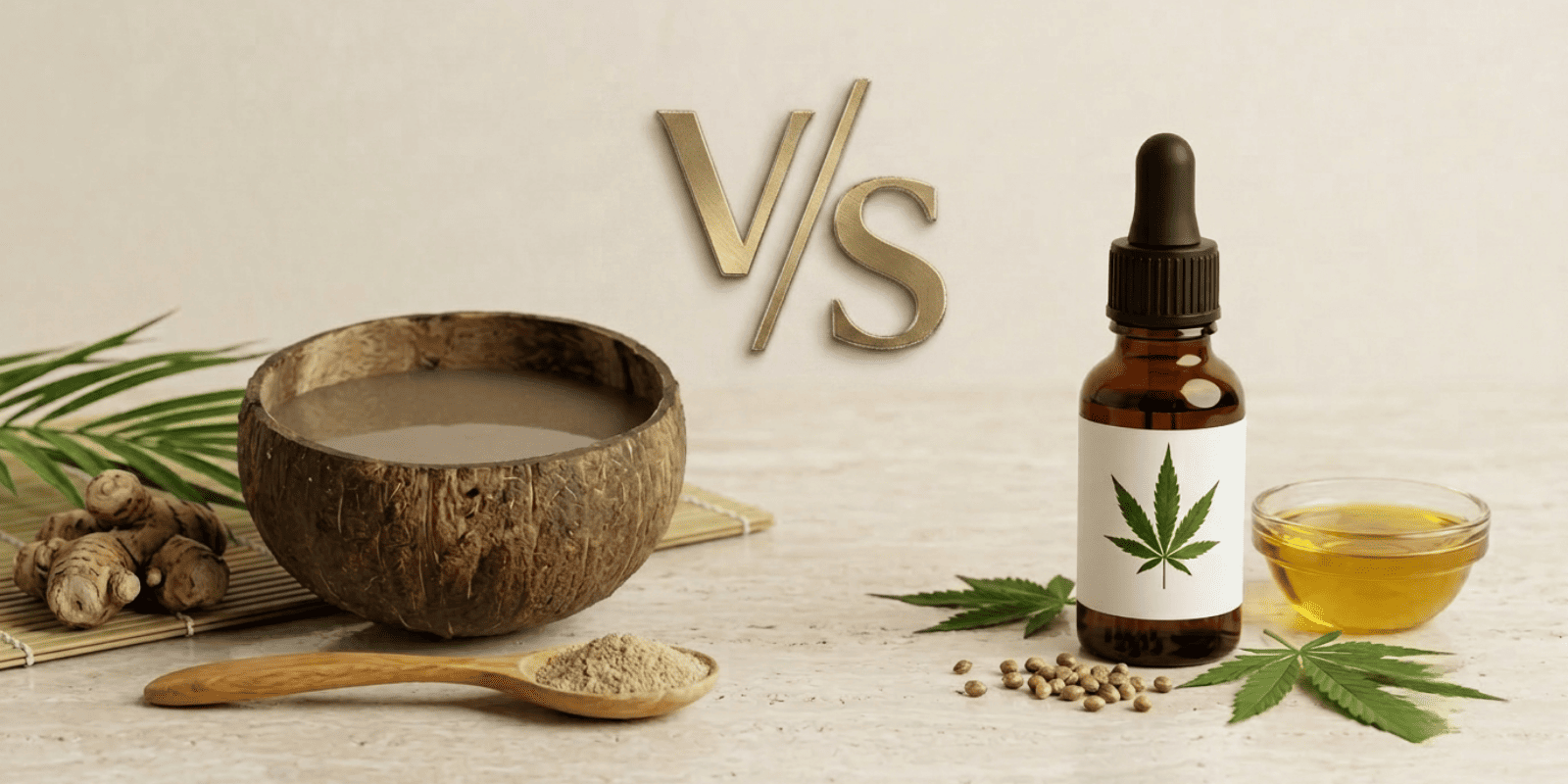
 Kava and CBD often get compared because both come from plants and appear in many modern products—but that’s where the similarities start to fade. They come from different plants, contain different active compounds, and have their own research, regulations, formats, and potential risks.
So, if you're wondering howKava vs CBD really compare, the answer may depend on more than you expect. Let’s look at what sets them apart, where they overlap, and which differences matter most.
Table of Contents
Kava vs CBD Differences
Kava vs CBD: Quick Comparison
Kava vs CBD: What are the Basic Differences?
Kava vs CBD Which Works Faster?
Kava vs CBD: Reported Effects
Kava vs CBD: Safety Considerations and Interactions
Kava vs CBD: Legal and Regulatory Differences
Which Is Better Kava or CBD?
FAQs
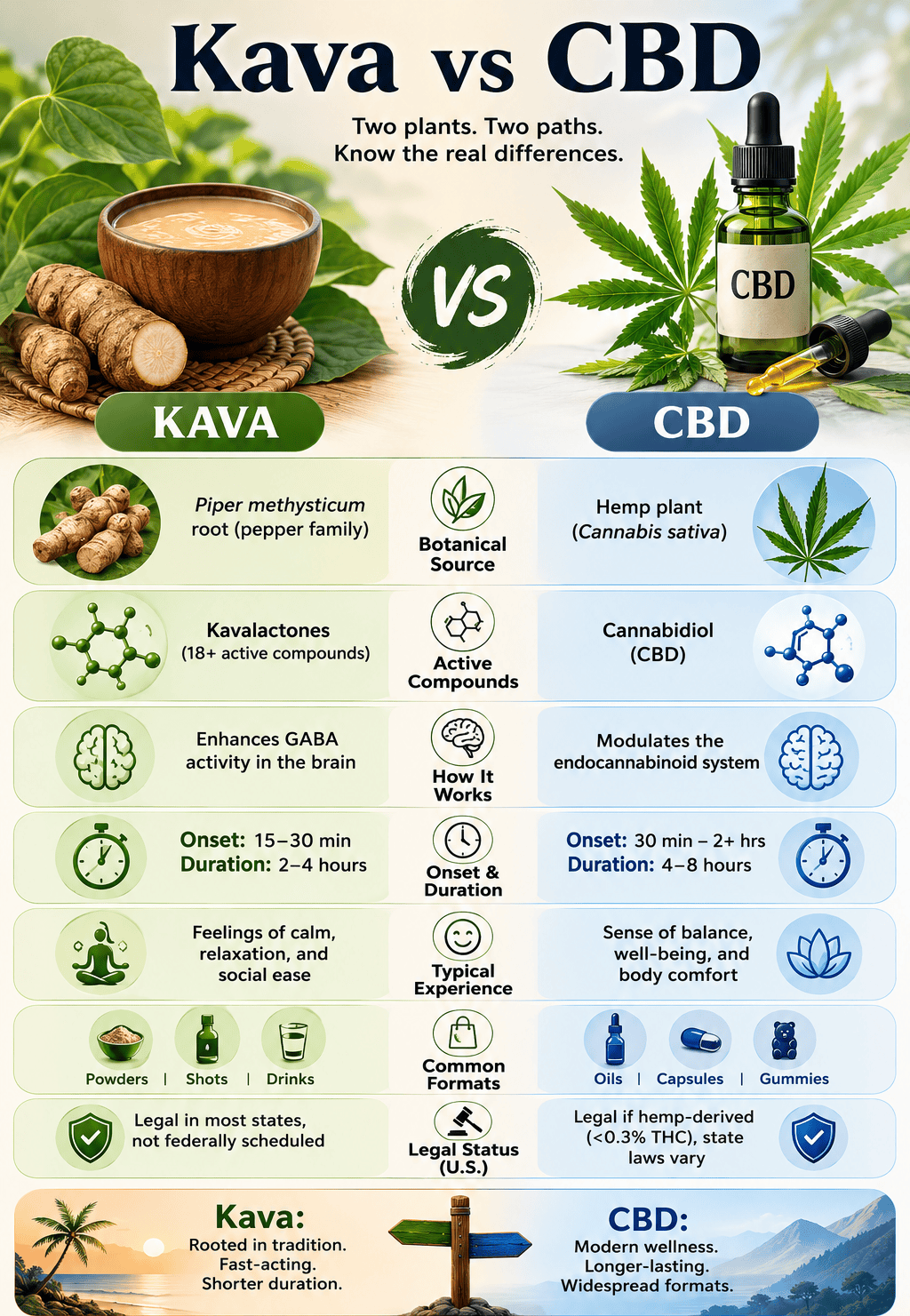
Kava vs CBD: Quick Comparison
The simplest way to understand the distinction is to compare the two across the factors people usually consider first:
Comparison Factor | Kava | CBD |
Botanical Source | Piper methysticum root (pepper family) | Hemp plant (Cannabis sativa) |
Active Compound | Kavalactones | Cannabidiol |
Primary Mechanism | Enhances GABA activity | Modulates the endocannabinoid system |
Onset Time | Very fast: 15 to 30 minutes | 30 minutes to 2+ hours (format-dependent) |
Duration of Effects | Short-acting: 2 to 4 hours | Long-acting: 4 to 8 hours |
Legal Status | Legal in most U.S. states, unscheduled federally | Federally legal if hemp-derived (under 0.3% THC), state laws vary |
Best For | Those interested in traditional Kava preparations, including root-based beverages and products | Those interested in hemp-derived cannabinoid products available as oils, capsules, gummies |
Kava vs CBD Differences
Before exploring the differences, let’s quickly understand the basics of Kava and CBD.
What Is Kava?
Kava is a traditional South Pacific beverage made from the crushed roots of the Piper methysticum shrub.
It has a long history of traditional beverage preparation in Pacific Island cultures and is now also found in products such as powders, extracts, and ready-to-drink beverages.
⭐ Trying Kava for the first time? Read our detailed guide to know more:
What Is CBD?
CBD (cannabidiol) is a natural chemical compound extracted from the flowers and leaves of the hemp plant.
Unlike THC, it is completely non-intoxicating and will not get you high. It is widely used as a daily supplement in oils, capsules, and gummies.
Kava vs CBD: What are the Basic Differences?
Now that the basics are covered, here's where the two really diverge — from where they grow to how they act on the brain.
1. Botanical Origins and Plant Anatomy
Kava
Kava comes from the root and rhizome of Piper methysticum, a shrub in the pepper family that grows in Vanuatu, Fiji, Hawaii, and other Pacific Island nations.
It takes years to mature, and the root is the only part used.
CBD
CBD is extracted primarily from the flowers and leaves of hemp, a low-THC variety of Cannabis sativa.
The highest concentrations are found in the trichomes of the flowers and leaves, rather than the stalks or roots.
2. Historical, Cultural, and Ceremonial Roots
Kava
Kava has a documented ceremonial history spanning centuries.
It is traditionally prepared and shared communally in Pacific Island cultures to mark milestones, welcome guests, and build social connection.
CBD
CBD doesn't carry the same ceremonial lineage.
It's a comparatively recent addition to mainstream the market, gaining traction after federal legalization opened the door to widespread commercial availability.
3. Active Chemical Compounds
Kava
Kava's effects come from kavalactones — a group of at least 18 identified compounds.
⭐The major active varieties include:
Kavain
Dihydrokavain
Methysticin
Dihydromethysticin
Yangonin
Desmethoxyyangonin
CBD
CBD is one of over 100 cannabinoids found in the cannabis plant, and it's the second-most-studied compound in the plant after THC, according to NCCIH.
Depending on the extraction method, products may feature isolated CBD molecules or a broader spectrum of secondary hemp compounds like CBG, CBN, and trace terpenes.
4. Mechanism of Action
Kava
🧠 How kava works:
Acts directly on the central nervous system.
Binds to GABA-A receptors and enhances how well gamma-aminobutyric acid (GABA) attaches to them.
This slows down overactive neural firing, which is part of why kava can feel noticeable fairly quickly.
According to the (NCCIH) Kava inhibits voltage-gated sodium channels, adding to its calming, muscle-relaxing feel.
CBD
💪 How CBD works:
Works more indirectly through the endocannabinoid system (ECS).
Doesn't bind CB1 or CB2 receptors head-on — instead, it acts as an allosteric modulator, essentially fine-tuning how they respond,
Slows the breakdown of anandamide, the body's own "bliss molecule," letting it stick around longer.
Also stimulates serotonin 5-HT1A receptors, which ties into its slower, more background sense of calm.
CBD vs Kava: Product Formats
The format can change how Kava and CBD fit into a person's preferences, from preparation requirements to portability:
Kava Formats | CBD Formats |
Traditional Kava beverages | Oils and tinctures |
Capsules | |
Gummies and other edibles | |
Capsules | Beverages |
Instant Kava mixes | Topical products |
Kava vs CBD Which Works Faster?
Kava works significantly faster than CBD.
Kava, when prepared as a traditional beverage, is generally felt within 15 to 30 minutes. That relatively fast, direct onset is tied to how quickly kavalactones interact with GABA pathways.
CBD's onset depends heavily on format:
Tinctures: roughly 30–90 minutes
Capsules/softgels: often longer, since they need to be digested first
Gummies: variable, depending on digestion
So if speed is the priority, kava as a beverage tends to be the faster option. CBD is built more for a gradual build-up than an immediate shift.
Kava vs CBD: Reported Effects
Both Kava and CBD have been researched for different properties, but their reported effects are not identical.
Here’s what you may experience as a Kava or CBD users:
What to Expect From Kava?
Mental Wind-Down: Kava may help create a calmer state of mind (PubMed Central).
Physical Calm: Kava might help relax your muscles and ease physical tension throughout the body (Healthline).
Mood Support: Users report that kava could promote a gentle sense of lightheartedness, sociability, and overall well-being (Science Direct).
Physical Sensation: Traditional kava preparations may cause a temporary, harmless numbing sensation on your tongue and lips — a normal effect of kavalactones, not a cause for concern (WebMD).
What to Expect From CBD?
Baseline Balance: Regular CBD use might help maintain a steady sense of calm during stressful daily routines, without altering your mental clarity (PubMed Central).
Restful Sleep: Taking CBD before bed may support healthier sleep cycles and ease the transition into nighttime rest (Science Direct).
Discomfort Management: It could assist in soothing anxiety, physical discomfort and easing general body stiffness (PubMed Central).
Mental Focus: Since it's non-intoxicating, CBD might help ground your thoughts without causing drowsiness during the workday.
Kava vs CBD: Safety Considerations and Interactions
Although Kava and CBD are both plant-derived compounds, they have different safety considerations based on their chemical composition, preparation methods, and possible interactions.
Kava Considerations
Liver Health Concerns: Prolonged use of poor-quality or non-traditional kava formulations might cause serious liver strain or injury. (NIH)
Temporary Drowsiness: Higher doses could impair your brain coordination, reaction times, and mental alertness. (NIH)
Dermatological Reactions: Heavy, long-term consumption may trigger temporary dry, scaly skin patches (Kava dermopathy).
Gastrointestinal Discomfort: Raw or poorly strained kava root powders could cause temporary nausea or stomach upset. (PubMed Central)
⭐ Read more on — Best Quality Kava: How to Choose Premium Kava Products
CBD Considerations
Systemic Fatigue: Routine consumption of CBD might result in mild drowsiness, dry mouth, or changes in appetite (Healthline).
Digestive Irritation: The carrier liquids used in CBD oils, like MCT oil, may provoke localized stomach irritation or loose stools (Healthline).
Product Discrepancies: Mislabeled products might contain unlisted contaminants or trace THC, which could trigger unexpected workplace drug test results.
Kava vs CBD: Legal and Regulatory Differences
Now that we have discussed all the major differences between CBD vs Kava. Let's explore how each one is regulated and what you should know about their legal classifications.
CBD's Legal Status
Here is the legal status of CBD:
Hemp-derived CBD (containing less than 0.3% THC) is federally legal in the U.S. under the 2018 Farm Bill
The FDA has determined that products containing THC or CBD cannot legally be sold as dietary supplements
Whether CBD products can be sold within a state still depends on that state's specific laws.
Rules around CBD in food and beverages vary widely from state to state.
Kava's Legal Status
Kava is not scheduled under U.S. federal drug law
It's legal to sell and consume in most states
Some states and municipalities have introduced age restrictions around kava sales
A few local ordinances specifically regulate kava bars and how kava can be sold
A Quick Note on Checking Local Laws
Legal status for both Kava and CBD can shift, and rules vary by state and even by city. It's always worth checking current local regulations before purchasing either product.
Which Is Better Kava or CBD?
There is no single answer to whether Kava or CBD is better because both come from different plants, contain different compounds, and are used in different product categories. The better choice depends on your preference:
Why Choose Kava?
Kava as an alcohol alternative: Kava might ease social nerves and loosen you up for an evening out, without clouding your thinking the way alcohol does.
For a defined wind-down: If you want something that marks the end of the day, kava may fit better as an evening ritual than a round-the-clock habit.
For occasional use: It suits targeted moments — after a stressful day, before a social event — rather than being something you'd reach for constantly.
When to Choose CBD?
For daytime use: CBD might support a calmer nervous system without making you feel foggy or sluggish, so it can fit into a workday.
For a consistent routine: It's built more for showing up daily, with effects that may add up gradually rather than hit all at once.
For all-around support: Because it works through the endocannabinoid system, CBD may offer broader, steadier support rather than a single targeted effect.
FAQs
Can You Take Kava And CBD Together?
Some people use them at different times of day instead of combining them which may lead to increased drowsiness and sedation. Therefore, it is recommended to use them separately and in moderation.
Is Kava Stronger Than CBD?
Kava and CBD work differently and are not directly comparable in strength. Their characteristics depend on the compounds, preparation methods, and individual factors.
Is Kava Safer Than CBD?
Neither is risk-free — kava carries a liver-injury concern with poor-quality products, while CBD's main risks come from mislabeling and drug interactions. Safety comes down to product quality and how you use it.
Does CBD Get You High?
No. CBD is non-intoxicating and doesn't produce the "high" associated with THC.
Is Kava Addictive?
Kava isn't generally considered addictive in the way alcohol or nicotine are, but heavy daily use isn't recommended.
How Can I Use Kava?
Kava is typically prepared as a traditional water-based beverage, or taken as a tincture, capsule, or powder mixed into a drink.
⭐Related reads:
Disclaimer: This article is for informational purposes only and is not medical advice. Research and regulations surrounding Kava and CBD may change, and individual responses can vary. Consult a qualified healthcare professional regarding potential interactions, and check applicable local laws before considering either option.